
The Participatory Action Research and Policy Advocacy Center Africa (PARPACA) applies a structured, multidisciplinary, and participatory approach to advance evidence-informed governance, policy reform, and sustainable development across Africa. Our research not only generates knowledge but also drives actionable insights that inform policy and programmatic interventions.
The Participatory Action Research and Policy Advocacy Center Africa (PARPACA) adopts a structured, multidisciplinary, and participatory research approach to advance evidence-informed governance, policy reform, and sustainable development across Africa. Our research goes beyond academic knowledge production; it is designed to generate practical insights and policy-relevant evidence that guide decision-making, inform development programmes, and strengthen institutional performance.
How We Work
- PARPACA designs research processes that actively involve communities, policymakers, and institutional actors from the outset. By jointly identifying priority issues, we ensure relevance, ownership, and impact.
- We employ rigorous academic methodologies, including mixed-methods research—quantitative surveys, qualitative interviews, focus groups, policy analysis, and participatory tools—to produce findings that are both scientifically credible and contextually grounded.
- Rather than conducting research on communities, PARPACA conducts research with communities. This participatory approach strengthens ownership, trust, and long-term impact, while ensuring that research priorities reflect real needs and lived experiences.
- Our methodology combines academic rigor with participatory practice. We apply mixed-methods research approaches that integrate both quantitative and qualitative techniques, allowing us to capture complex social realities and generate comprehensive insights.
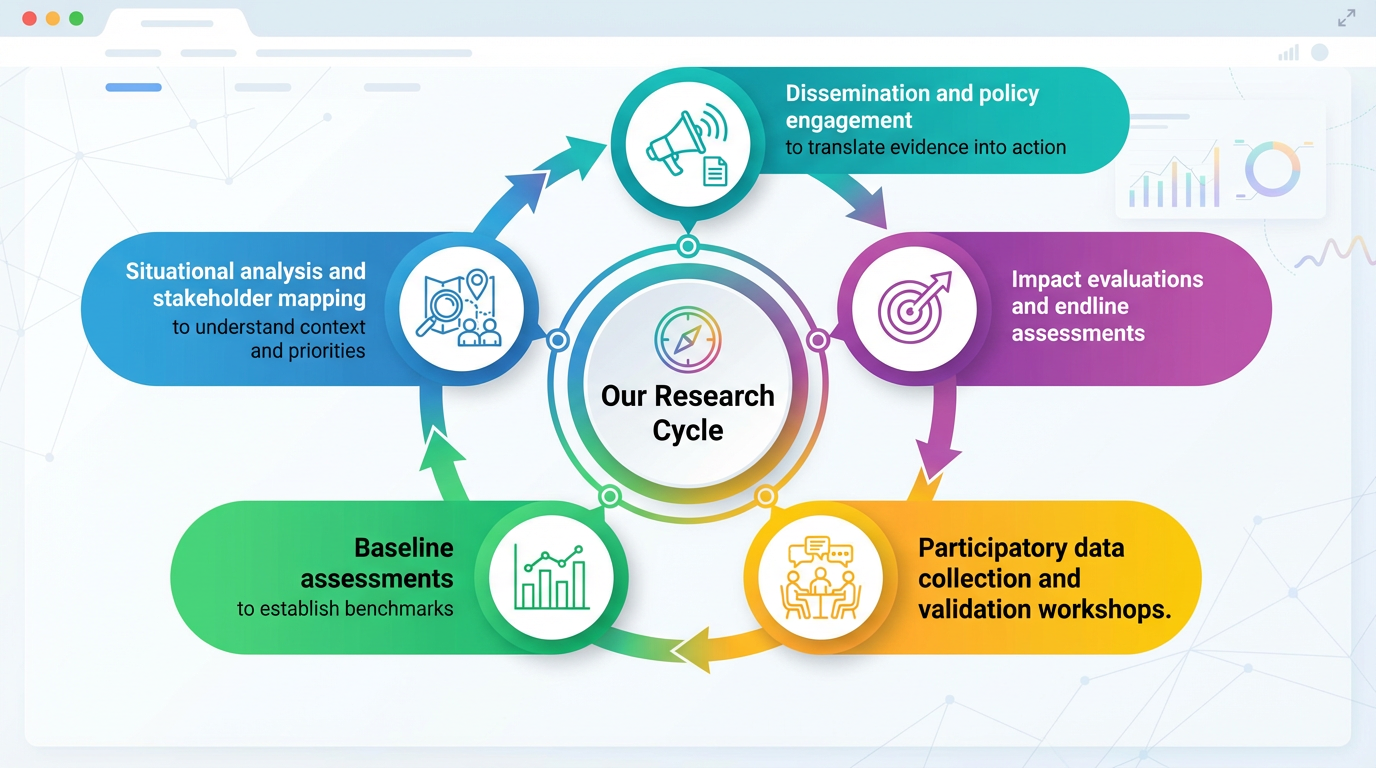
Our Research Cycle
Key research methods include:
- Quantitative surveys to collect large-scale statistical data and identify measurable trends and patterns.
- Qualitative interviews with key informants such as policymakers, community leaders, and sector experts to capture deeper perspectives.
- Focus group discussions that bring together diverse community members to explore experiences, perceptions, and potential solutions.
- Policy and institutional analysis to examine governance structures, legal frameworks, and policy implementation gaps.
- Participatory research tools such as community mapping, participatory rural appraisal, and stakeholder workshops that enable communities to contribute directly to knowledge generation.
- By combining these approaches, PARPACA ensures that research findings are scientifically credible, contextually grounded, and practically applicable.
PARPACA follows a systematic research cycle that ensures the generation of reliable evidence and meaningful policy impact.
Situational Analysis and Stakeholder Mapping
We begin by conducting a comprehensive analysis of the social, economic, and institutional context. This includes identifying key stakeholders—government institutions, community groups, civil society organisations, private sector actors, and development partners—whose engagement is essential to the research processe.
Baseline Assessments
Baseline studies establish the initial conditions and benchmarks before a programme or policy intervention begins. This data provides a reference point that allows future progress and impact to be accurately measured.
. Participatory Data Collection and Validation
PARPACA conducts mid-term and final evaluations to assess the effectiveness, efficiency, sustainability, and impact of policies or development programmes. These evaluations help determine what works, what does not, and what improvements are necessary.
Impact Evaluations and Endline Assessments
PARPACA conducts mid-term and final evaluations to assess the effectiveness, efficiency, sustainability, and impact of policies or development programmes. These evaluations help determine what works, what does not, and what improvements are necessary.
Dissemination and Policy Engagement
Research findings are translated into policy briefs, reports, dialogue forums, and stakeholder consultations. This ensures that evidence reaches decision-makers and influences policy design, programme implementation, and institutional reforms
Join the Movement
Policy change doesn’t happen in a vacuum. It requires bold ideas, credible evidence, and united voices. At PARPACA, we invite collaboration — with policymakers, researchers, donors, and grassroots advocates alike — to turn insights into impact.
 Email: advocacy@parpaca.org/info@parpacaafrica.org
 Phone: +49 (0) 1573 988 22 86 /+256 (0)256 702 449287
 Website: www.parpacaafrica.org